
What Legendary, Epic and Rare Mean in a Matchup Gap
By Betty Sports · · 6 min read
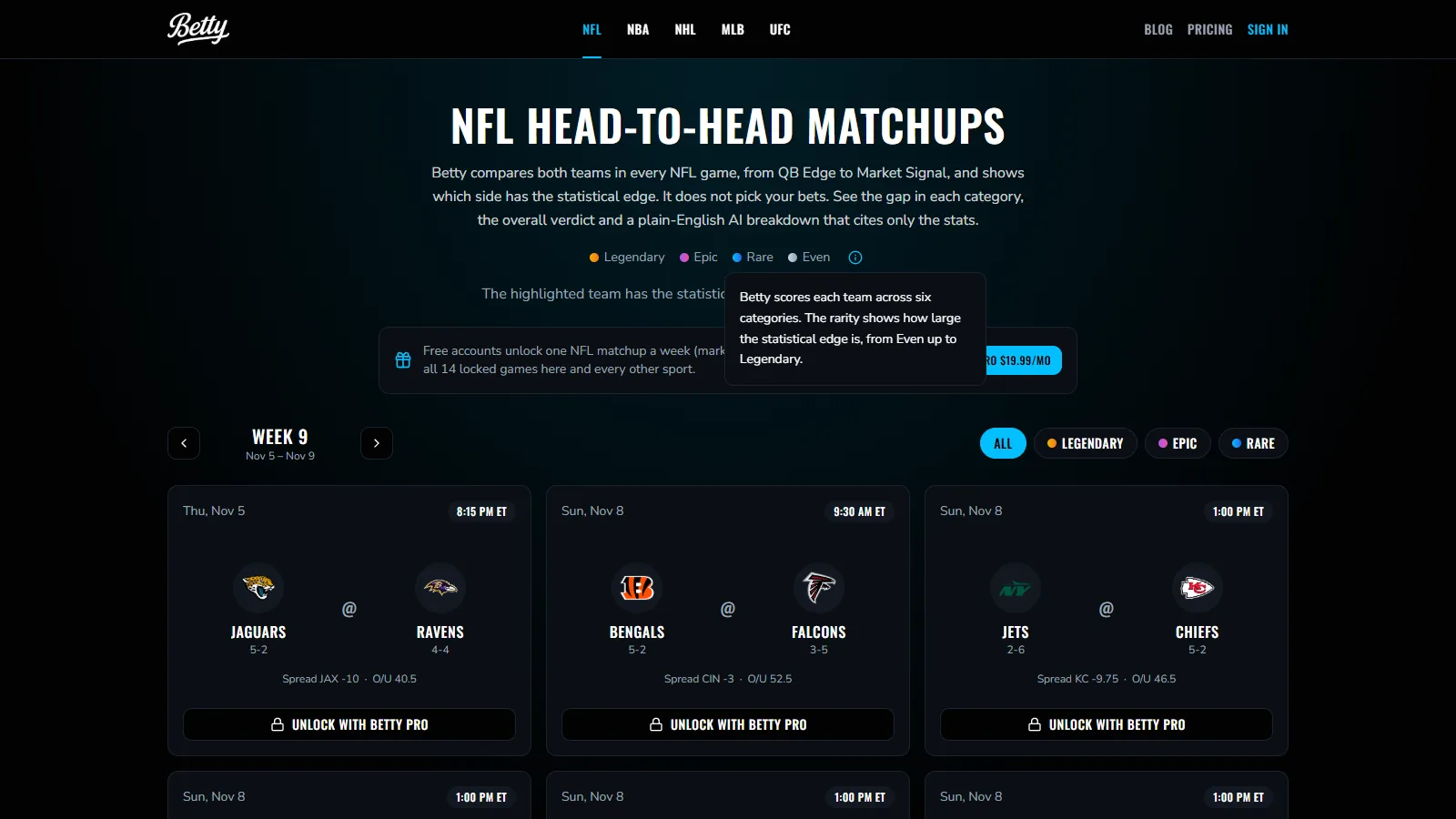
Legendary, Epic, Rare and Even are Betty's labels for how large the gap is between two sides in a category. A gap of 15% or more is Legendary, 10% or more is Epic, 5% or more is Rare, and anything under 5% is Even. They measure the size of an edge, not the chance of winning.
If you have opened a Betty matchup, you have seen the colored badges beside each row. They are quick to read and easy to over-read. This post explains what each tier is, how the badges roll up into the overall rating, and the common ways people misuse them.
What does each rating tier mean?
| Rating | Gap between the sides | How to read it |
|---|---|---|
| Legendary | 15% or more | A large difference in that category |
| Epic | 10% or more | A clear difference |
| Rare | 5% or more | A modest but real difference |
| Even | Under 5% | No meaningful separation |
The names borrow from collectible-card rarity: the bigger the gap, the higher the tier, and a high tier is meant to stand out from the rest of the slate.
Is a Legendary gap the same as a sure win?
No, and this is the misreading to avoid. A Legendary label says one side is far ahead on the measured stats in that category. It does not say the other side cannot win. Sports have injuries, bad weather, hot streaks and plain luck, and no rating removes them.
Betty states this directly: a Legendary edge is a statistical gap, not a promise. Reading it as one is how people get hurt.
How are the ratings shown on a matchup?
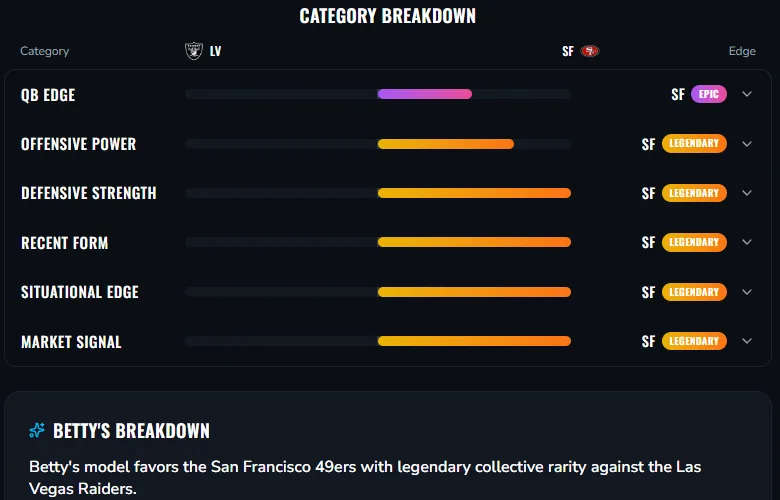
Each game has six categories, and each category row carries its own badge next to the name of the side that holds the edge. A category that comes out under the 5% line shows as Even with no highlighted side. The opened matchup also shows one overall rating at the top, which comes from the same scale applied after all six categories are weighed together.
How does a set of category ratings become one verdict?
Categories are not equal. The algorithm weights them, so a Legendary gap in a heavily weighted category pushes the verdict further than the same label in a lightly weighted one. The result is a collective verdict that highlights the side with the edge, or marks the game Even when nothing separates.
That is why two games with the same overall rating can look different underneath. One may be built on a single big gap, another on several medium ones. Always open the rows, which is where the shape of the edge shows up. The head-to-head method explains why shape matters.
Why does Even matter as much as Legendary?
Because it tells you where not to look. If two goaltenders grade as Even, the game will not be decided there, and your attention belongs on the categories that do separate. An Even row is information, not an absence of it.
It also protects you from false precision. Small differences are mostly noise, so treating a 2% gap as a finding is a mistake that the Even label is designed to prevent.
What are common mistakes when reading the tiers?
- Reading Legendary as a prediction that the highlighted side wins.
- Counting badges instead of looking at which categories hold them.
- Ignoring an Even row that sits where you expected an edge.
- Assuming a high tier is permanent. Ratings move as odds and stats update, and the verdict locks at game time.
- Treating the rating as advice about how much to wager, which it never is.
What does a tier look like in different sports?
The scale is the same everywhere, but the story behind a badge changes. In football, a high tier at QB Edge usually means a clear gap between the two starting quarterbacks on efficiency stats. In hockey, a high tier at Offensive Power points to a team creating and finishing more chances than the other. In a UFC fight, a high tier at Striking means one fighter lands more and absorbs less.
This is why it helps to read the category name along with the badge. Epic in Recent Form and Epic in Market Signal are both Epic, but they are different kinds of evidence. One says something about the team, the other about where money and opinion have settled. Putting the badge and the category together is how you read a row correctly.
Betty keeps the labels consistent so that you can learn them once and apply them to every sport you follow.
Why use tiers instead of showing raw percentages?
Tiers make a long list of numbers scannable. A matchup has six categories, and each category has a handful of stats inside it. Without a summary label you would need to read every number to find the one that matters. The badge lets you spot the biggest difference at a glance, and the expanded stats are still there if you want the detail.
Tiers also set a floor on what counts as a finding. A gap under 5% is labeled Even on purpose, so that noise does not get dressed up as insight.
How should you compare one Epic against several Rares?
Do not add them up like points. One Epic in a category that matters for the sport, such as the quarterback in football, can say more than three Rares in categories that rarely decide games. The collective verdict handles this by weighting, and you can apply the same judgment by hand: ask which categories decide this sport, then look at the tiers there first.
Can a side win the verdict while losing some categories?
Yes. The verdict is built from weighted gaps, so a side can trail in a category or two and still hold the collective edge if its leads are larger or sit in heavier categories. That is a feature, since it keeps one minor lead from overruling a big one elsewhere.
Do the ratings work the same way in every sport?
The scale is identical across sports, so a Rare gap means the same thing in football, basketball, hockey, baseball and UFC. What changes is the category list underneath. Compare the NFL categories with fighter categories like striking and grappling and you will see the same tiers applied to very different questions.
How can you see the ratings on a real game?
Open any sport page and use the Legendary, Epic and Rare filters at the top of the slate to jump to the games with the biggest gaps. Select the info icon next to the legend for a one-line reminder. Start free to open this week's featured matchup in every sport with the full category breakdown.
Betty Sports is for information only. Betty does not accept wagers. You must be 21 or older. If you or someone you know has a gambling problem, call 1-800-GAMBLER.
Frequently asked questions
- What is the difference between Epic and Rare?
- Epic means the gap between the two sides in a category is 10% or more, while Rare means 5% or more. Epic is the larger gap. Both sit below Legendary at 15% or more and above Even, which covers anything under 5%.
- Does a Legendary rating mean the team will win?
- No. It means that side has a large statistical advantage in the measured stats. Games are still decided by injuries, weather and chance, so Betty treats a Legendary edge as a gap on paper and not as a promise of any result.
- What does Even mean on Betty?
- Even means the gap between the two sides is under 5%, so neither side is meaningfully ahead in that category. If the whole matchup rates Even, no team or fighter is highlighted as having the edge.