
NFL Matchup Analysis: The Six Categories That Decide a Game
By Betty Sports · · 8 min read
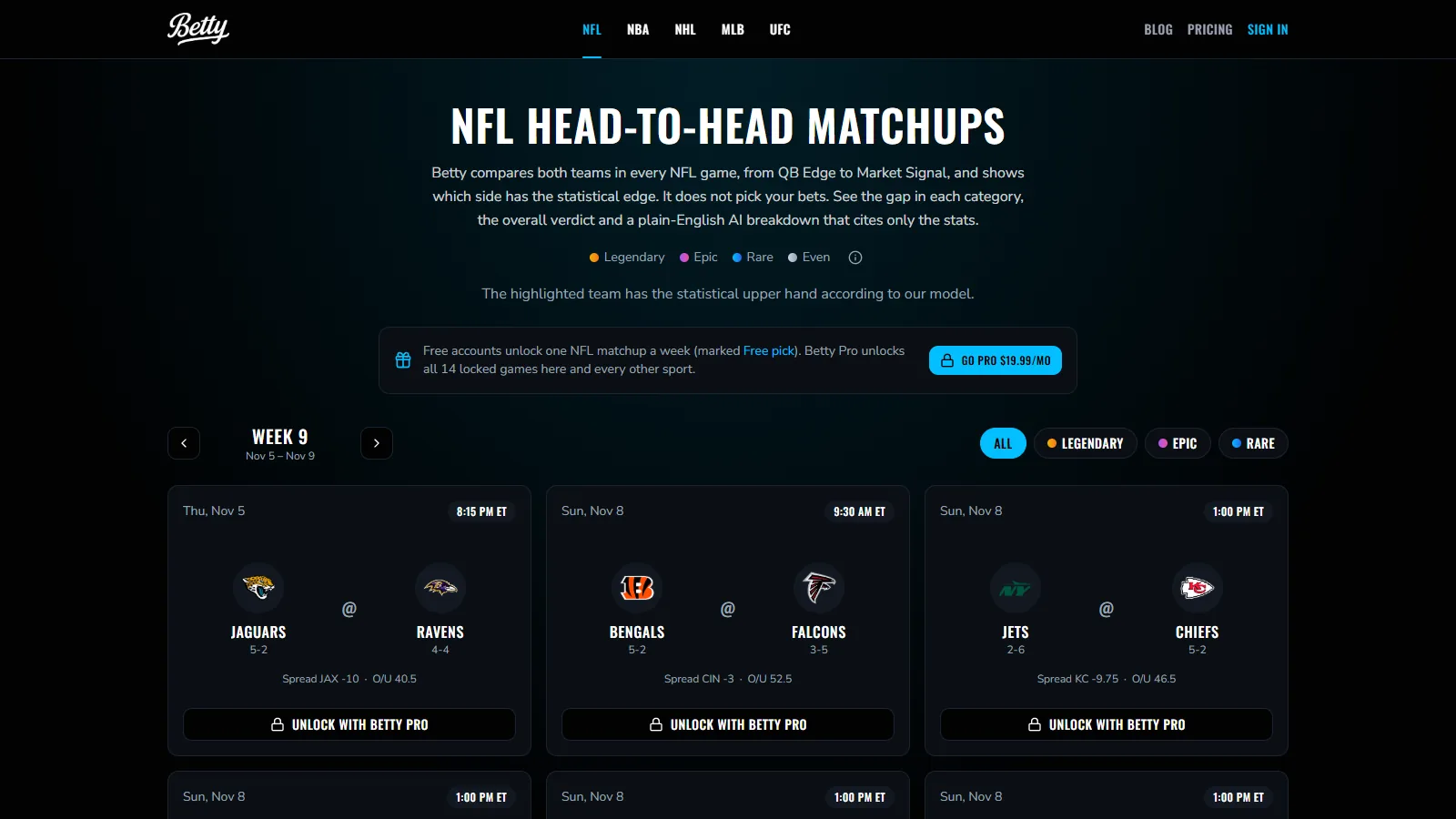
NFL matchup analysis is easiest when you break a game into six parts: the quarterback, the offense, the defense, recent form, the situation around the game, and what the betting market is saying. Compare both teams in each part, note the size of every gap, and the overall picture follows.
Those six parts are how Betty scores every NFL game, and they are a sensible checklist even if you never open the app. Below, each category is explained with the stats that sit inside it, what to look for, and where it can mislead you.
What is QB Edge, and why does it come first?
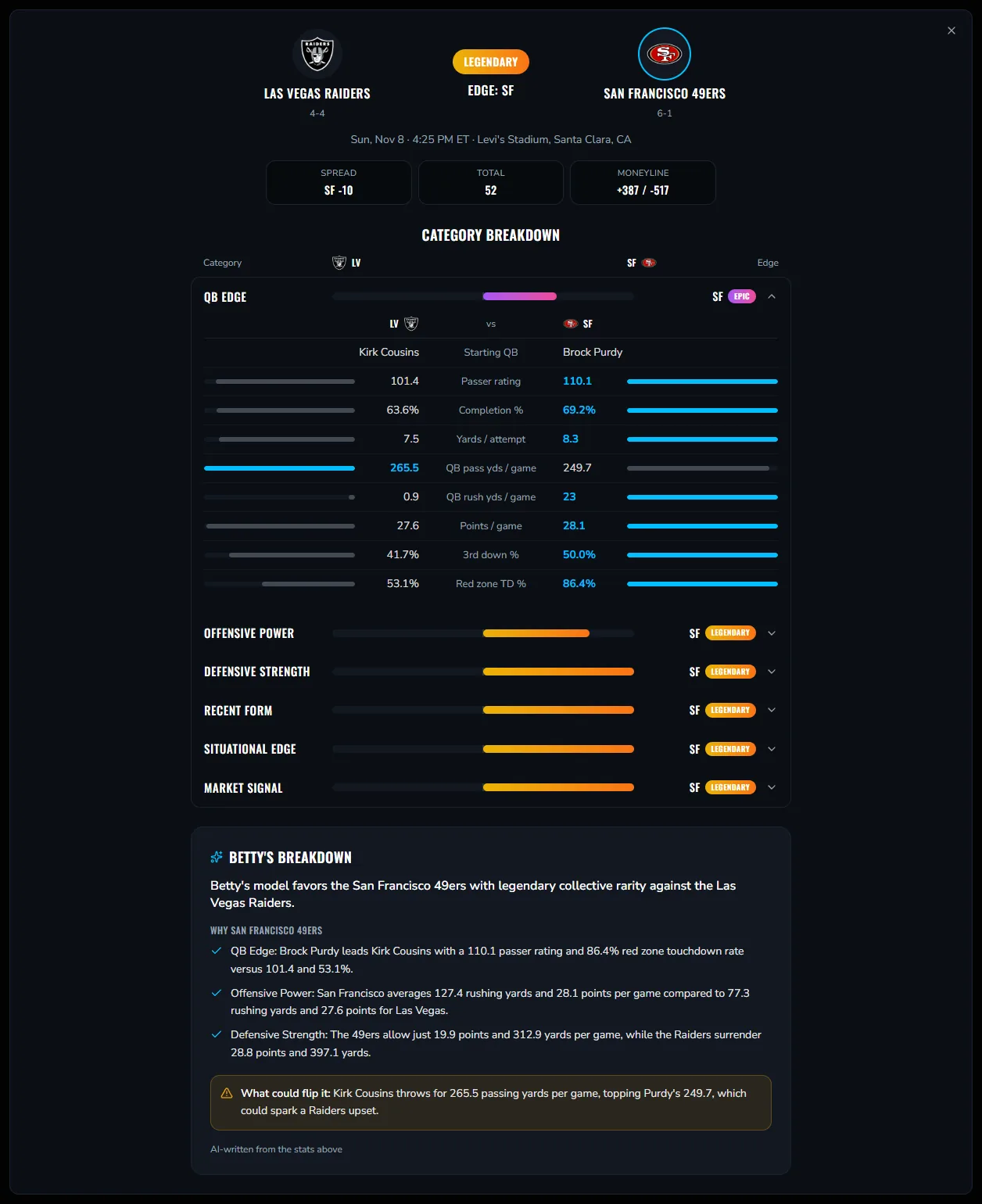
QB Edge compares the two starting quarterbacks head to head. Football is built around that position, so it earns its own category rather than being buried in team offense.
Inside it you will find the starter's name, passer rating, completion percentage, yards per attempt, passing yards per game and rushing yards per game, alongside team points per game, third-down percentage and red zone touchdown percentage. Look for efficiency gaps, such as yards per attempt, rather than raw volume, which depends on game script. Watch for a quarterback change: a new starter makes season numbers a poor guide.
What does Offensive Power measure?
Offensive Power covers how well each team moves the ball and scores, independent of who is throwing it. The stats include points per game, total yards per game, third-down percentage, red zone touchdown percentage, rushing yards per game and explosive play percentage.
Yards and points do not always travel together. A team can pile up yardage between the twenties and stall near the goal line, which is why red zone conversion is listed on its own. When a team ranks well in yards but poorly in the red zone, expect fewer points than the yardage suggests.
How is Defensive Strength scored?
Defensive Strength flips the same lens onto stopping the other side. It covers points allowed per game, total yards allowed, third-down stop percentage, red zone stop percentage, passing and rushing yards allowed per game, and sacks per game.
For stats like points allowed, lower is better, and a good comparison tool has to keep that straight or it will reward the wrong team. Pay attention to the split between pass defense and run defense. A strong run defense matters less against a team that mostly throws.
Why does Recent Form get its own category?
Because a season average hides trends. Recent Form looks at the last four games: the record, any streak, the average margin, points for and against, and the win percentage of the opponents faced during that stretch.
That last item is the one people skip. Three wins against weak opponents tell a different story from three wins against playoff-caliber teams. Four games is also a small sample, so treat form as a nudge, not a verdict.
What counts as Situational Edge?
Situational Edge captures the circumstances of this specific game: home field, rest, division games and weather. The rows include season record, days of rest, whether it is a division game, whether the venue is indoors, kickoff temperature, wind and precipitation.
Weather is the most concrete of these. Strong wind can limit the passing game and kicking, and an indoor game removes the question altogether. Rest matters when one team is playing on a short week and the other is not. Betty pulls game-time weather from Open-Meteo.
What is Market Signal?
Market Signal reads the betting market: the spread, the opening spread, the moneyline, the total and the opening total. It includes how the line has moved, because movement shows where the information went.
The market is a piece of evidence, not the answer. It reflects a lot of smart money, which makes it a useful check on your own view, and it also reflects public opinion, which can skew a price. Betty uses it as one category out of six so that it cannot drown out the on-field stats. Lines come from The Odds API.
How do the NFL categories interact?
The categories overlap in ways worth noticing. A strong quarterback often lifts offensive power, so a gap at QB Edge and a gap at Offensive Power may be one edge counted twice. A strong defense can also shape recent form, since low-scoring wins show up in the average margin.
When two categories move together, ask whether they reflect one underlying strength. If they do, treat them as one point of evidence rather than two. When they point in opposite directions, for example a better offense against a better defense, you have a genuine tension, and that is where the game is likely to be decided.
Situational Edge and Market Signal are the most independent of the rest, which is why they are useful cross-checks. If the stat-based categories and the situation agree, the picture is cleaner. If they split, the explanation in the breakdown deserves a careful read.
Which NFL category should you read first?
Read QB Edge first, then check whether anything about the situation, such as a late injury report or wind, overrides it. Quarterback and situation are the two categories most likely to change between the time a slate is published and kickoff, so they deserve the freshest look.
Save Market Signal for last. If you read the line first, it is hard not to anchor on it, and the other five categories end up as decoration for a conclusion you already reached.
How do the six categories combine into one verdict?
Each category produces a gap between the two teams, and Betty rates that gap from Even up to Legendary. Those ratings roll up into a collective verdict that highlights the team with the edge. If neither side separates, the game is rated Even and no team is highlighted. For the scale itself, see what Legendary, Epic and Rare mean.
Notice that a team can win some categories and still not have the collective edge. A big gap at quarterback and a thin one in defense is a very different shape from six medium gaps, and the verdict reflects that.
How can you apply this to a game this week?
- Start with QB Edge and note whether either starter is new or questionable.
- Compare offense to defense across the matchup, not just offense to offense.
- Check form against the strength of opponents faced.
- Look at rest and weather before anything else on the situational row.
- Use the market last, as a sanity check.
- Name the risk: the one thing that could flip your read.
Betty does steps one through five on every game and writes step six in the AI breakdown. If you want to learn the framework in general, the five-step head-to-head method works for any sport. To see all of this week's games, open the NFL matchups page, and start free to unlock the featured game.
Betty Sports is for information only. Betty does not accept wagers. You must be 21 or older. If you or someone you know has a gambling problem, call 1-800-GAMBLER.
Frequently asked questions
- What are the six NFL categories on Betty?
- QB Edge, Offensive Power, Defensive Strength, Recent Form, Situational Edge and Market Signal. Each one compares both teams on a group of related stats, and the gap in each category is rated from Even to Legendary.
- Where does Betty's NFL data come from?
- Schedules, scores and team stats come from ESPN, betting lines from The Odds API, and game-time weather from Open-Meteo. Betty is not affiliated with or endorsed by those providers or by the NFL.
- Does the NFL page show every game for free?
- Every game shows its matchup card, but one featured matchup per sport each week is fully unlocked on the Free plan. Betty Pro opens the full breakdown for every game in every sport.
- Does Betty tell me which NFL team to bet?
- No. Betty shows which team has the statistical edge and why, and it does not select bets. It is not a sportsbook, and it does not accept wagers.