
AI Sports Picks vs AI Matchup Analysis: Which One Helps You Decide?
By Betty Sports · · 7 min read
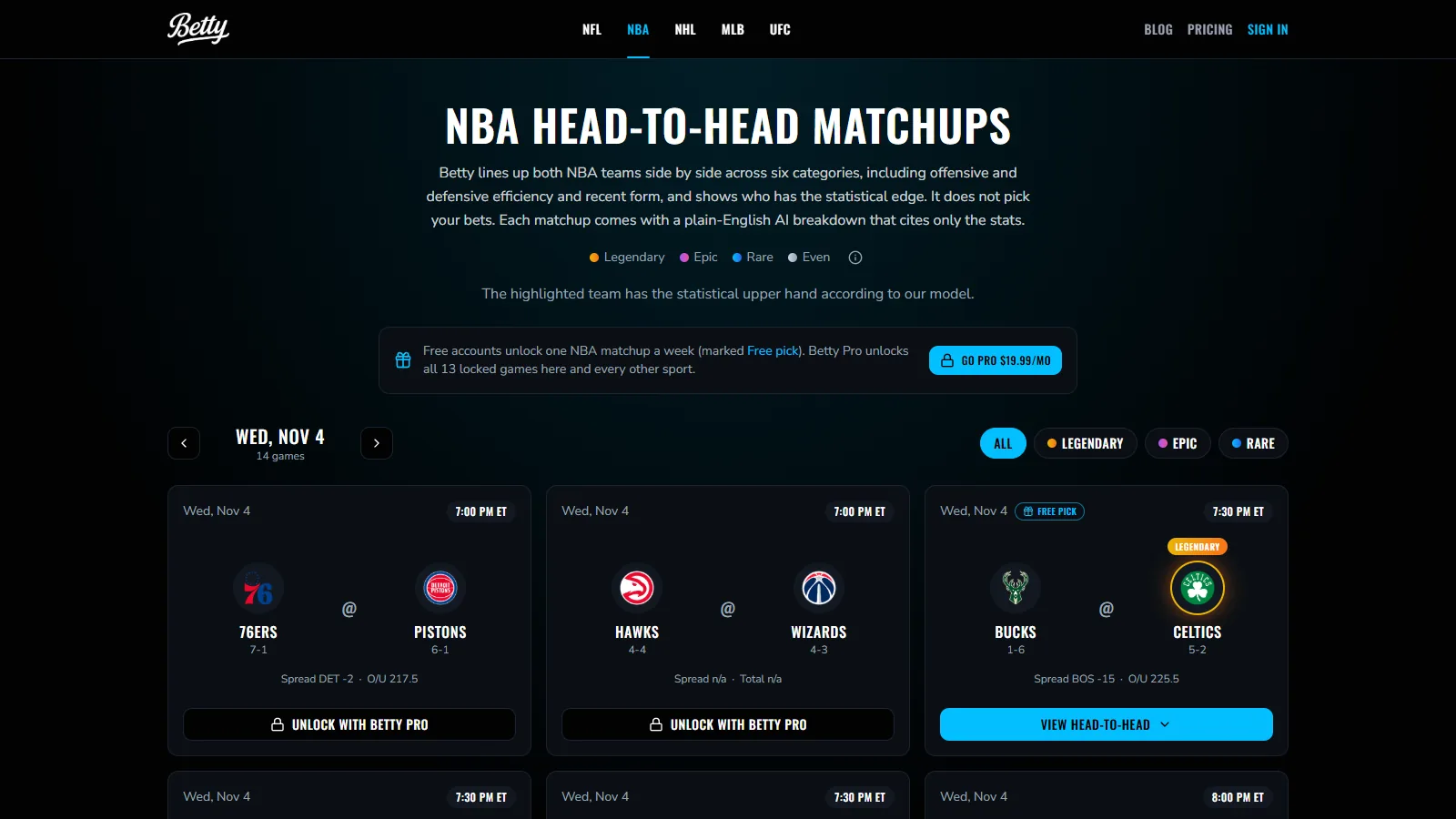
AI sports picks hand you a side to back. AI matchup analysis compares two teams or fighters and shows who has the statistical edge, how big it is and where it comes from. The first gives you an answer to copy. The second gives you evidence to weigh, which is the difference between following and deciding.
People often search for "ai sports picks" when what they really want is a faster way to understand a game. This post separates the two ideas so you can pick the one that fits how you actually bet, or whether you want to bet at all.
What are AI sports picks?
AI sports picks are model-generated selections: this team, this side of the spread, this total. The output is a recommendation. Whatever the model did to reach it usually sits behind the curtain, and what you receive is a conclusion.
That format is easy to consume, and that is its appeal. It is also its weakness. A pick has no texture. You cannot tell whether it rests on a quarterback mismatch or a weather quirk, and you cannot tell how fragile it is.
What is AI matchup analysis?
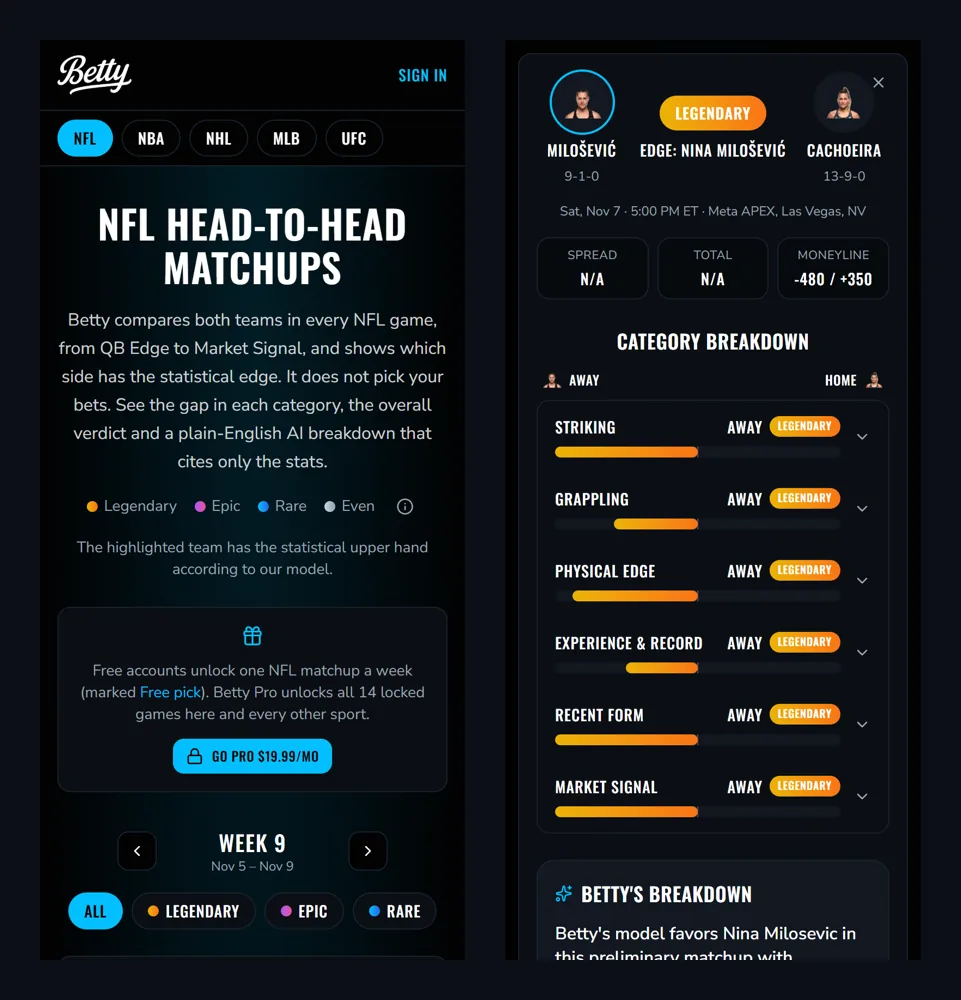
Matchup analysis starts from the comparison instead of the conclusion. It lines up both sides across the things that decide a game, measures the gap in each area, and rolls those gaps into one view of who holds the edge. You see the reasoning first and the summary second.
Betty works this way. A proprietary algorithm scores both sides in six sport-specific categories, rates each gap as Legendary, Epic, Rare or Even, and highlights the side with the collective edge. It stops there on purpose: Betty does not pick bets.
How do the two approaches differ side by side?
| AI picks | AI matchup analysis | |
|---|---|---|
| What you get | A selection to back | A comparison and a size of edge |
| Reasoning | Often hidden | Visible by category |
| Who decides | The tool, in effect | You |
| Handles uncertainty | Rarely | Names what could flip it |
| Best for | Copying a view | Building your own view |
Why does visible reasoning matter?
Because games change. A starting quarterback is ruled out on Saturday, a goalie rests on the second night of a back-to-back, the line moves. A pick that was built on Tuesday's information becomes stale without telling you. Analysis you can read lets you spot that the premise shifted.
It also protects you from the loudest voice in the room. When you can see that a gap comes mostly from one category, you can ask whether that category is relevant tonight, and you stay in charge of the call.
When are picks the better fit?
If you do not want to look at any numbers and simply want a view to react to, a picks product matches that habit. Be honest with yourself about what you are buying, though. A selection with no shown work is an opinion, and opinions are cheap. Check the checklist for choosing an AI betting tool before you pay for one.
When is matchup analysis the better fit?
It suits anyone who already forms their own opinions and wants the legwork done: the stats gathered, both sides compared, the biggest differences surfaced. It also suits people who follow a sport and just want a clean way to understand a game, with no wager involved.
Take a football game. Open the NFL page and a matchup shows quarterback play, offense, defense, recent form, situational factors and market signal as separate rows, each with a rating for how far apart the teams are. You can agree with the verdict, or you can look at the one row you care about and decide the gap there matters more.
What does Betty's AI-written breakdown add?
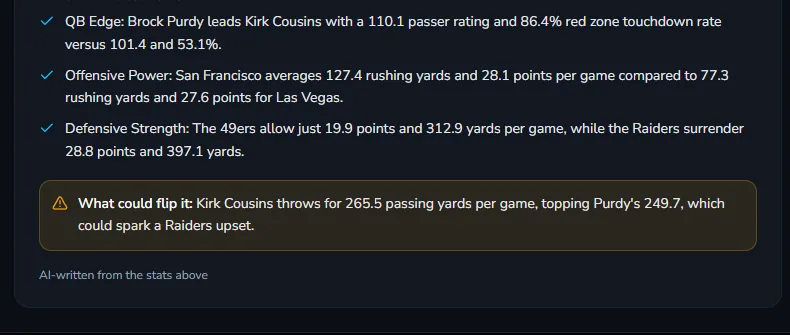
Each matchup carries a short plain-English summary written by AI from the stats in the analysis. It gives a takeaway, three reasons, and what could flip the result. It cites only the stats shown, which is what keeps it readable and checkable. Think of it as the paragraph a well-prepared friend would say out loud after reading the numbers.
Does analysis mean Betty is hiding the pick?
No. There is a highlighted side, because the collective verdict names who has the edge. That is a statement about the numbers, not an instruction to wager. Whether a gap is worth acting on, at what price, and with how much money, is outside what Betty tells you. If you want to see how a verdict is built end to end, read how AI sports predictions work.
Why do so many people search for AI picks?
Because deciding is hard and a ready-made answer feels like relief. The search itself is a sign of how much information there is to sort through: injuries, lines, schedules, form. Wanting a shortcut is reasonable. The risk is mistaking a shortcut for a verified answer, and that is the gap this post is about.
A comparison view is also a shortcut, but one that ends with you holding the evidence rather than somebody else's conclusion.
What does a five-minute routine with matchup analysis look like?
Skip the verdict at first and read the category rows from top to bottom. For each row, ask whether the gap matches what you already know about the two teams. If a row surprises you, expand it and read the stats underneath. A surprise is where the learning happens: either the model found something you missed, or it is leaning on a number that has gone stale.
Then read the AI breakdown and compare its listed reasons with your own notes. Where you agree, your confidence is earned. Where you disagree, you have a specific question to research instead of a vague feeling.
Can you combine analysis with someone else's pick?
Yes, and it is a good way to use both. Treat the pick as a hypothesis and the comparison as the test. If a pick says a team is the play and the matchup view shows that team behind in four of six categories, you have found a conflict worth understanding before you act. Maybe the pick-maker knows something about an injury. Maybe it is a guess. Either way you learn more than you would by following blindly.
The reverse works too. If the numbers point one way and a pick points the other, the disagreement is the interesting part, and the category rows show you where to dig.
How can you try the analysis approach?
The Free plan opens one featured matchup per sport each week with the full view, so you can judge the format on a real game. Start free or browse the NFL matchups to see the layout first.
Betty Sports is for information only. Betty does not accept wagers. You must be 21 or older. If you or someone you know has a gambling problem, call 1-800-GAMBLER.
Frequently asked questions
- Are AI sports picks the same as predictions?
- Not quite. A pick tells you what to bet. A prediction estimates what may happen. Matchup analysis sits beside both: it compares the two sides and shows the size and source of any statistical edge, leaving the decision to you.
- Does Betty give picks?
- No. Betty highlights which side has the statistical edge in a matchup and rates the gap, but it does not select your bets or tell you what to wager. It is also not a sportsbook and does not take bets.
- Can analysis and picks be used together?
- Yes. Some bettors read a pick as a starting question and then open the comparison to see whether the numbers support it. The comparison is what lets you test someone else's view instead of just accepting it.