
How AI Sports Predictions Work: Stats, Not Magic
By Betty Sports · · 7 min read
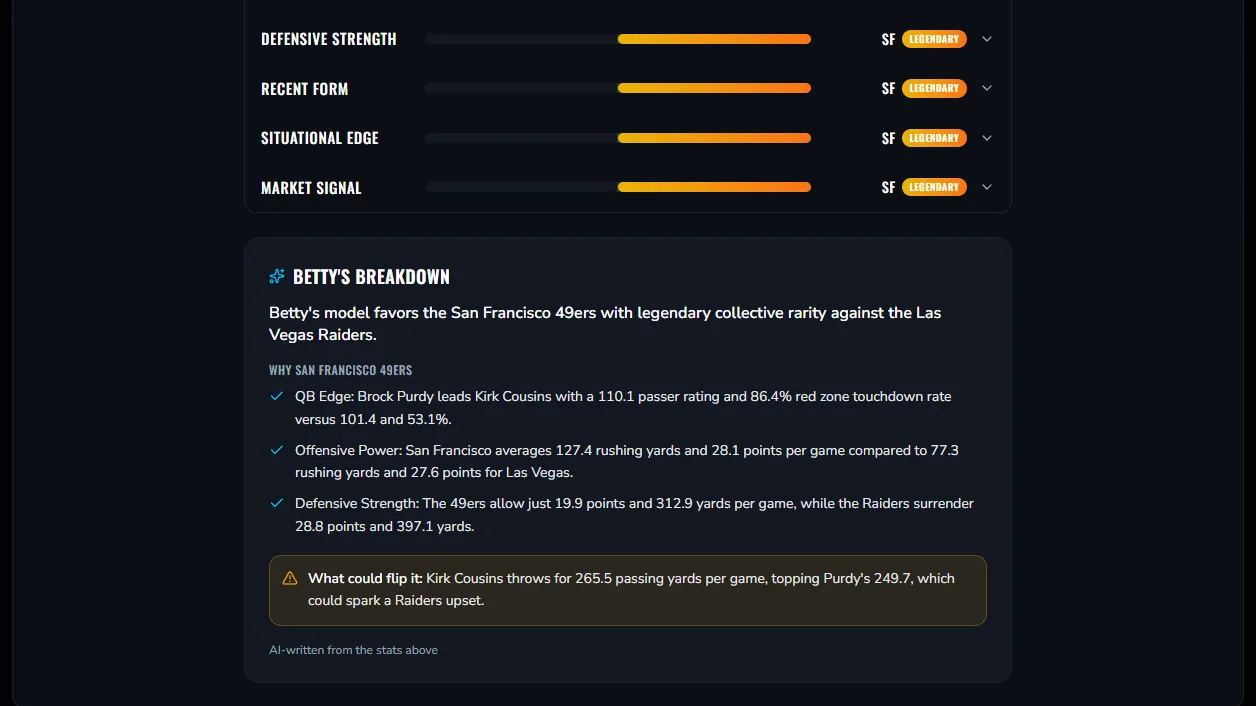
AI sports predictions work in four stages: collect data about both sides, turn it into comparable scores, weigh those scores into one overall view, and describe the result in plain language. There is no crystal ball in the middle. The quality of the output depends on the quality of the stats going in.
"AI" is a loaded word in betting, so it helps to be concrete. Below is what happens at each stage, using how Betty builds a matchup as the worked example, and where the real limits are. Understanding the pipeline is also the best defense against tools that dress up a guess as a forecast.
Stage 1: Where does the data come from?
Everything starts with feeds. Betty pulls schedules, scores and team stats from ESPN, betting lines from The Odds API, baseball data from the MLB Stats API, hockey data from the NHL API, and game-time weather from Open-Meteo. Betty is not affiliated with or endorsed by those providers or any league.
Two consequences follow. First, a model is only as current as its feeds, so analysis updates as odds and stats change. Second, missing data is a real problem. When an input is not available, a careful system leaves it out instead of inventing a value.
Stage 2: How do raw stats become scores?
Raw numbers cannot be compared directly: yards, percentages and rest days live on different scales. The algorithm groups related stats into categories and converts each one into a score for each side, keeping the direction right so that fewer points allowed counts as better.
Betty uses six categories per sport, chosen to fit how that sport is decided. Football has a quarterback category, baseball has starting pitching and bullpen, and UFC has striking and grappling. A generic template across sports would misread them all.
Stage 3: How are the scores weighed into one view?
The gap between the two sides in each category is measured and rated: Legendary at 15% or more, Epic at 10%, Rare at 5%, and Even below that. Categories carry different weights, and the weighted results combine into a collective verdict that highlights the side with the edge.
This is the part people call machine learning or AI, but the honest description is a transparent scoring model. The value is not that it is mysterious. It is that it applies the same rules to every game, so it does not get swayed by a star name or a recent highlight the way a person does. The full tier scale is explained here.
Stage 4: What does the AI actually write?
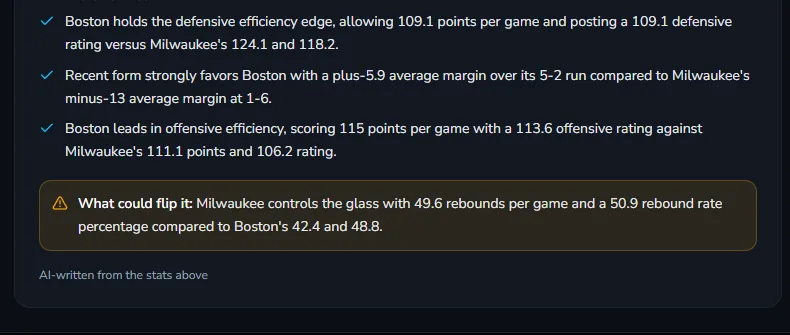
A language model turns the scored analysis into a short, readable summary. In Betty that is a takeaway, three reasons and what could flip the result, and it is restricted to citing only the stats in the analysis. It narrates the numbers; it does not add facts of its own.
The summary is regenerated only when the underlying inputs change, so what you read matches what the scoring saw.
Is that a prediction or an analysis?
The industry blurs this. A prediction claims what will happen. An analysis states what the numbers favor and by how much. Betty sits on the second side of the line: it shows who has the statistical edge, does not pick bets, and does not promise an outcome. Words like prediction and forecast are used loosely in search results, and Betty is explicit about the difference. See AI picks vs AI matchup analysis.
What are the limits of any AI sports model?
- It cannot see what is not in the data: an off-field issue, a minor injury not yet reported.
- Small samples are noisy, especially early in a season or for fighters with few bouts.
- Markets already price in a lot, so beating them is hard for anyone.
- A model can be wrong in a streak and right in a streak without that proving anything.
- Late changes, such as a scratched goalie, can reshape a game after the analysis was written.
This is why every Betty breakdown includes what could flip the result, and why a verdict locks at game time and is graded publicly. The point of grading is to keep the system answerable to what happened.
What happens when some data is missing?
Real feeds have gaps. A probable starting pitcher may not be announced yet, a fighter may have limited stats, a line may not be posted. A careful model handles this by leaving the affected input out rather than filling in a guess. In Betty, a category can come out blank or Even when an input it needs is unavailable, and the rest of the analysis still stands.
For a reader, the takeaway is to look at which rows are populated. A verdict built on all six categories is more informative than one built on four, and the panel makes the difference visible.
Why do sport-specific categories matter to a model?
A model that uses the same inputs for every sport will misjudge most of them. Football turns on the quarterback and the line of scrimmage, baseball on the starting pitcher, hockey on goaltending and shot quality, a fight on how two styles collide. By fixing six categories per sport, Betty forces the comparison to ask the right questions first.
It also keeps the output legible. When the categories mean something to a fan of the sport, you can read the result without a statistics degree and disagree with it on specifics.
What is a transparent model worth compared with an opaque one?
Transparency does not make a model more accurate, but it makes it more useful. With an opaque model you can only accept or ignore the answer. With a transparent one you can find the input you disagree with, adjust for news the model has not seen, and keep what is still sound. That is the practical case for showing the work.
How can you check an AI tool's pipeline yourself?
Ask the same four questions of any product: what data, how scored, how weighed, what written. If a vendor cannot answer in plain language, you are looking at a black box. The checklist for evaluating AI betting tools turns that into a seven-point test.
What does this look like on a real game?
Open a matchup on the NBA page or any other sport page and read the rows top to bottom. The stats are the first layer, the badges are the second, the breakdown is the third. Start free to open a featured matchup in each sport with all three layers.
Betty Sports is for information only. Betty does not accept wagers. You must be 21 or older. If you or someone you know has a gambling problem, call 1-800-GAMBLER.
Frequently asked questions
- Is Betty's AI predicting who wins?
- No. Betty's algorithm scores both sides and shows who has the statistical edge and by how much. The AI only writes the plain-English summary of that analysis. Betty makes no promise about outcomes and does not pick bets.
- What data feeds AI sports models like Betty?
- Betty uses ESPN for schedules, scores and team stats, The Odds API for lines, the MLB Stats API, the NHL API, and Open-Meteo for weather. The analysis refreshes as odds and stats change before game time.
- Does the AI write anything not in the stats?
- It is instructed to cite only the stats from Betty's own analysis. The summary names the main edges and one risk that could flip the result, so you can check each claim against the category rows.
- Can AI replace my own research?
- It can shorten the research by gathering and comparing the stats, but it cannot see everything. Injuries, late lineup changes and context still need your judgment, which is why Betty shows its work.