
UFC Fighter Comparison: Striking, Grappling and Experience
By Betty Sports · · 7 min read
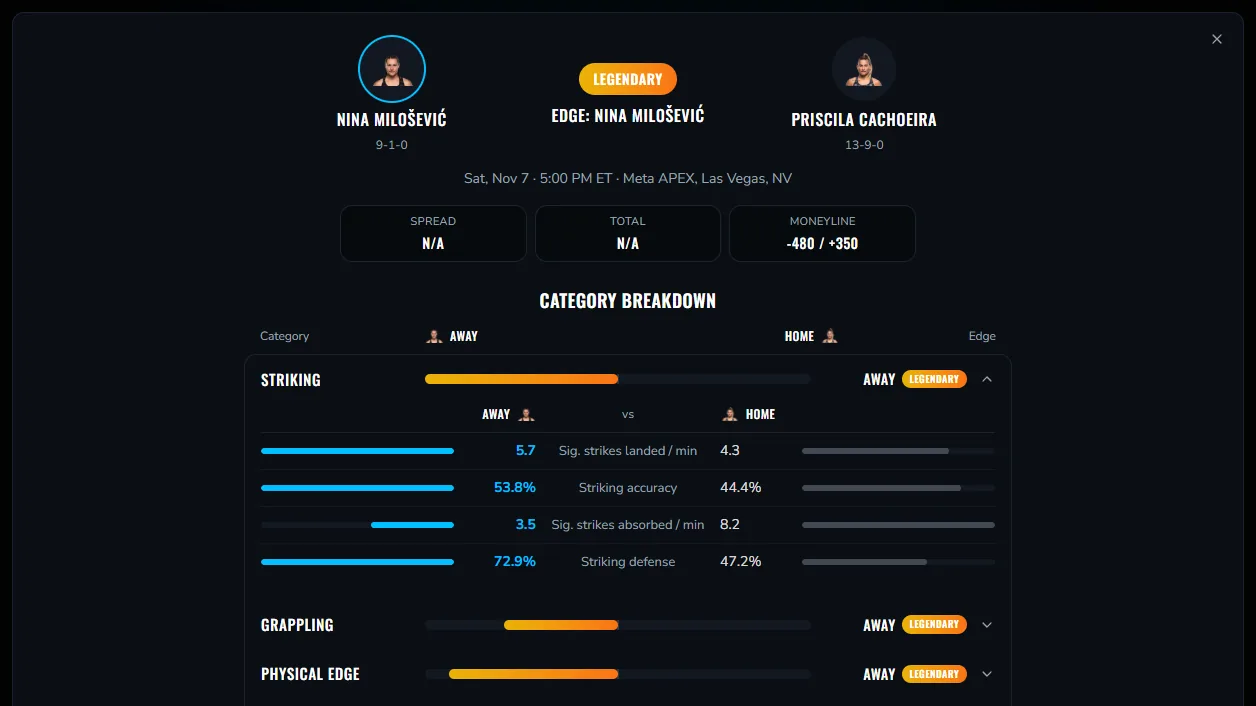
A useful UFC fighter comparison looks at five things: striking, grappling, physical edge, experience and recent form, with the betting market as a sixth reference point. Compare how each fighter does on offense and defense in each area, because fights are decided where one fighter's strength meets the other's weakness.
MMA is the hardest sport to compare because styles interact in odd ways. A great striker can be neutralized by a wrestler, and a wrestler can be stuffed by a sharp defender. This post goes through each category Betty uses for fighters, the stats inside it, and the mistakes people make when they read them.
How do you compare striking?
Striking compares offense and defense on the feet. Betty's rows are significant strikes landed per minute, striking accuracy, significant strikes absorbed per minute and striking defense.
Definitions matter here. UFC.com describes significant strikes as including all strikes at distance plus power strikes in the clinch and on the ground, and it describes striking defense as the percentage of significant strikes attempted against a fighter that do not land (see any UFC.com athlete stats page for the wording). So volume and accuracy tell you how much a fighter lands, while absorbed strikes and defense tell you how hard that fighter is to hit.
Read the two halves together. A fighter who lands a lot but also absorbs a lot is in exchanges that can go either way. One who lands often and absorbs little has a clean edge.
How do you compare grappling?
Grappling covers takedowns and submissions: takedowns per 15 minutes, takedown accuracy, takedown defense and submission attempts per 15 minutes. UFC.com defines takedown defense as the percentage of takedowns attempted against a fighter that do not land.
The key comparison is cross-over: one fighter's takedown offense against the other's takedown defense. A fighter with elite takedown numbers and an opponent who rarely gets taken down means the stat has not been tested, and that uncertainty is worth naming.
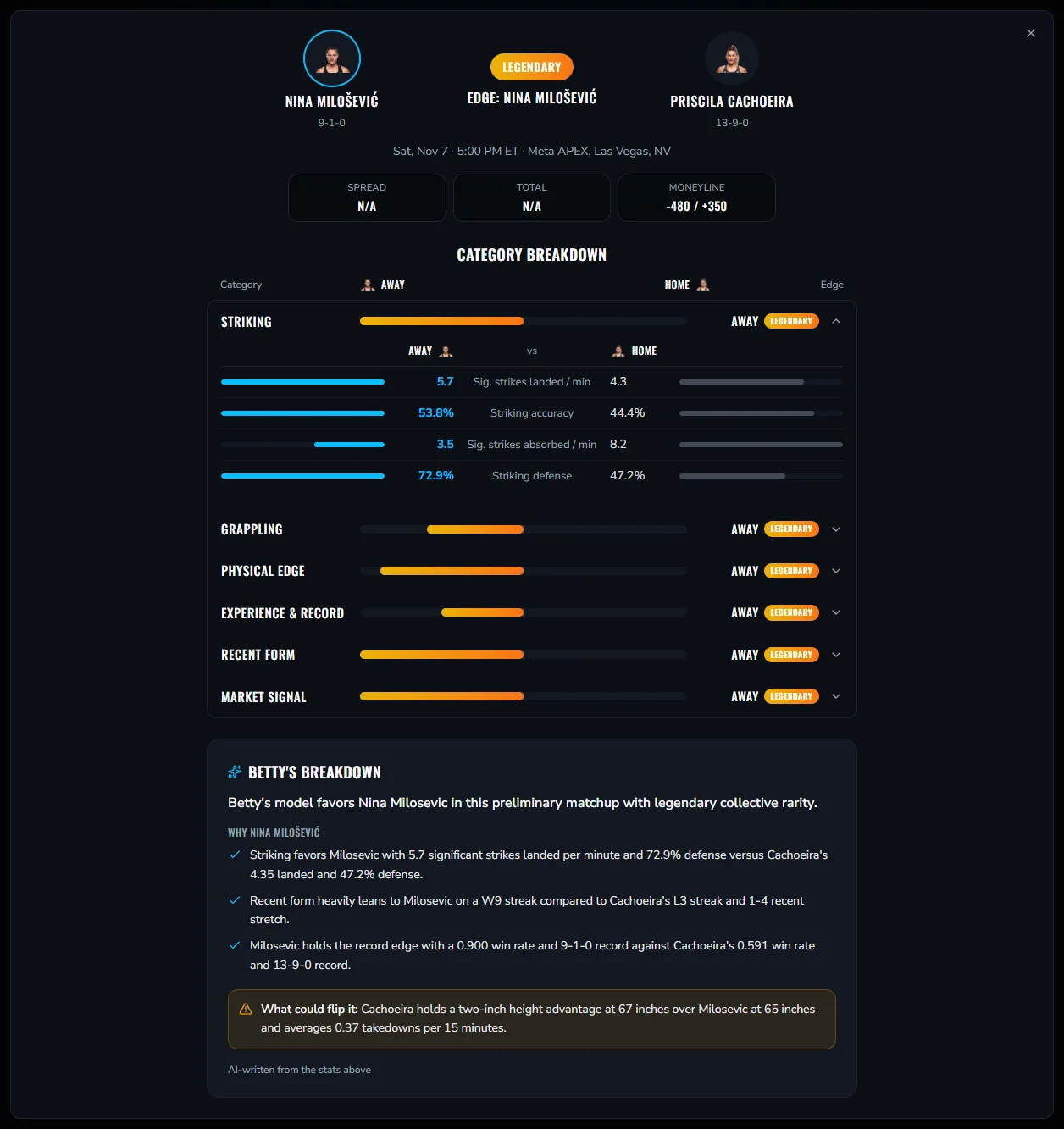
What is Physical Edge?
Physical Edge looks at the body: reach, height, age and stance. Reach matters most for strikers who work at range, and a long reach against a shorter opponent can control distance. Age is scored the other way, with younger counted as an advantage, but it is a soft factor and should not outweigh results.
Stance is the odd one out. It is a descriptor rather than a better-or-worse number: an orthodox fighter facing a southpaw is a style puzzle, not an edge for either.
How should you weigh Experience & Record?
This category covers professional record, wins, win percentage and finish rate. Experience shows how often a fighter has been tested, and the finish rate shows how fights tend to end.
Be careful with records. Eight wins against regional opposition is not the same as eight wins against top-ten opponents, and a long record can hide a decline. Use it as context, and let the striking and grappling categories carry the fight-specific information.
Why does Recent Form matter in MMA?
Fighters change quickly, and fights are infrequent, so the last few bouts count. Betty looks at the last five results, the current streak and the date of the last fight. A long layoff or a loss by knockout can change a fighter. Treat form as a flag to investigate rather than a number to trust blindly.
Where does the betting market fit?
Market Signal shows the moneyline for the fight. It is an outside view that already includes information such as camp news and training reports that stats do not capture. If your comparison disagrees sharply with it, check what you may be missing before you trust either.
What do finish rate and win percentage tell you?
Win percentage shows how often a fighter has won, and finish rate shows how often those wins ended before the final bell. Together they describe a fighter's shape: a high-finish fighter tends to create big swings, while a decision-heavy fighter tends to win rounds more slowly.
Neither number says who the opponents were, so read them with context. A high win percentage built against weaker competition may not carry over to a tougher matchup. A modest rate against strong opposition can be the more impressive record.
Use these figures to judge variance. Fights involving two high-finish fighters have more ways to end suddenly, which is a reason to hold any read of the stats a little more loosely.
How do styles make fights?
Stats describe tendencies, and styles decide how those tendencies meet. A fighter with strong striking numbers who faces an opponent with a poor striking defense should have room to work. If that opponent is a high-volume wrestler, though, the question becomes whether the striker can defend takedowns, so the cross-over between categories matters more than either column alone.
This is where the side-by-side format helps. Seeing both fighters' offense and defense in the same view lets you ask which fighter gets to impose their game, and what happens if neither does.
What if a fighter has few professional fights?
Treat the numbers with extra caution. Averages built on a handful of bouts move a lot with one result, and a fighter who has faced limited opposition may have stats that flatter them. Look at the strength of the opponents behind the figures, and lean less heavily on categories where the sample is thin.
How do you bring it together?
- Match each fighter's offense against the other's defense, in striking and in grappling.
- Ask where the fight is likely to be fought: standing or on the mat.
- Check reach and age as modifiers, not drivers.
- Use record and form to judge reliability of the stats.
- Look at the market last and note any disagreement.
- Name what could flip it, such as a takedown that lands once and changes the fight.
Betty rates the gap in each category from Even to Legendary and rolls them into one collective verdict, explained in the rating guide. The general process is laid out in the five-step head-to-head method.
To see a full card, open the UFC fights page. The Free plan unlocks one featured fight per week with the complete breakdown, so start free and read the categories for yourself.
Betty Sports is for information only. Betty does not accept wagers. You must be 21 or older. If you or someone you know has a gambling problem, call 1-800-GAMBLER.
Frequently asked questions
- What stats does Betty use to compare UFC fighters?
- Betty compares striking, grappling, physical edge, experience and record, recent form and the market. Inside those are stats such as strikes landed per minute, takedown defense, reach, finish rate and the last five results.
- Is reach really an advantage in the UFC?
- It can help a fighter control range, especially a striker. It is a modifier rather than a decider, which is why Betty places it in Physical Edge next to age and stance instead of treating it as the main factor.
- Where does Betty get UFC data?
- Fight cards and fighter data come through ESPN, and betting lines come from The Odds API. Betty is not affiliated with or endorsed by the UFC or by any data provider.
- Does Betty pick the winner of a fight?
- No. Betty highlights which fighter has the statistical edge and rates how large it is, but it does not pick bets, accept wagers or promise an outcome.